How Parker Conrad Built a $13.5B Empire by Ignoring Silicon Valley
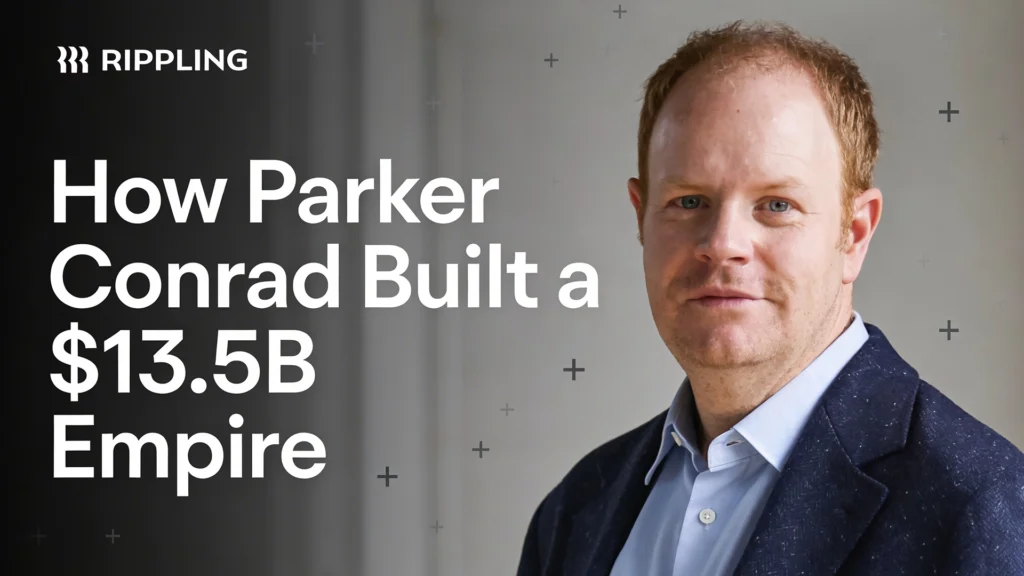
The most dangerous thing in business is conventional wisdom.
If you walk into any startup accelerator today, you will be handed the exact same playbook: Build a Minimum Viable Product (MVP). Find a tiny niche. Do one thing better than anyone else. Never boil the ocean.
Parker Conrad looked at that playbook, threw it in the trash, and built a $13.5 billion empire by doing the exact opposite.
With Rippling, he didn’t build a single product. He built 15. At the exact same time.
Here is the story of the ultimate Silicon Valley redemption arc, and the invention of the “Compound Startup.“
A compound startup is a business that develops and launches multiple integrated products or services, often leveraging shared resources, technology, or market insights to drive growth across all areas simultaneously. This approach allows the startup to scale faster by tapping into various revenue streams and diversifying its offerings.
The Context: The Fall from Grace
To understand Rippling, you have to understand Zenefits.
In 2013, Parker Conrad founded Zenefits ( now Trinet), a revolutionary HR software company. It was the fastest-growing SaaS company in history, hitting a $4.5 billion valuation in two years.
Then, it spectacularly imploded over compliance issues. Conrad was ousted by his own board. He became a cautionary tale, the poster child for “moving too fast and breaking things.”
Most founders would have retired to a private island. Conrad was furious. He knew the core thesis of Zenefits was right, but the execution was flawed. He decided to build it again, but this time, he was going to break every rule in the VC handbook.
The Problem: SaaS Sprawl
Over the last decade, companies adopted the “Best of Breed” philosophy.
You buy Workday for HR, Gusto for payroll, Expensify for expenses, Okta for identity, and Jamf for device management.
The result? SaaS Sprawl. A 500-person company now uses 150 different software apps. None of them talk to each other. When an employee is hired, an IT person has to manually enter their name, role, and manager into 15 different systems. It is an administrative nightmare.

The Playbook: The Compound Startup
Conrad realized that the friction wasn’t the software itself; it was the underlying data. Every single business application relies on the exact same core dataset: The Employee Graph (Who are you, what is your role, who is your manager, where do you live?).
So, he didn’t build an HR app. He built a data platform.

Once he had the core Employee Graph, he deployed the “Compound Startup“ strategy. Instead of focusing on one niche, Rippling built a massive, interconnected suite of products simultaneously: Payroll, Benefits, IT Device Management, Identity (SSO), and Spend Management.
The power: Because they share the same underlying data, the automation is god-tier.
If you promote an engineer to a manager in Rippling, the system automatically adjusts their payroll, issues them a corporate card with a higher limit, gives them access to manager-level GitHub repositories, and updates their Slack permissions. Instantly.
Founder Lessons: The Anti-MVP
- Deep Integration > Best of Breed. Rippling’s individual tools might only be 80% as good as a specialized competitor. But because they are 100% integrated with each other, the system is infinitely better.
- The “Boil the Ocean” Moat. Building a compound startup is excruciatingly difficult. It takes years of R&D before you have a sellable product. But once it’s built, the moat is impenetrable. A competitor can’t just copy one feature; they have to copy the entire ecosystem.
- Harness the Chip on Your Shoulder. Conrad’s ouster from Zenefits gave him a relentless, almost terrifying drive to prove the Valley wrong. He channeled that anger into operational discipline.
Final Word
Parker Conrad proved that the “Lean Startup” isn’t a law of physics. It’s just a trend.
Sometimes, the customer doesn’t want a perfectly crafted, single-purpose tool. Sometimes, they just want someone to fix the whole damn system.
Rippling is the revenge of ambition. It is the proof that if you have the talent and the capital, boiling the ocean is exactly what you should do.

Tumisang Bogwasi
Tumisang Bogwasi is an award-winning entrepreneur and strategist sharing insights on business growth, leadership, and innovation.